
The Little Armored One
How the migrating armadillo defies categories in science and law

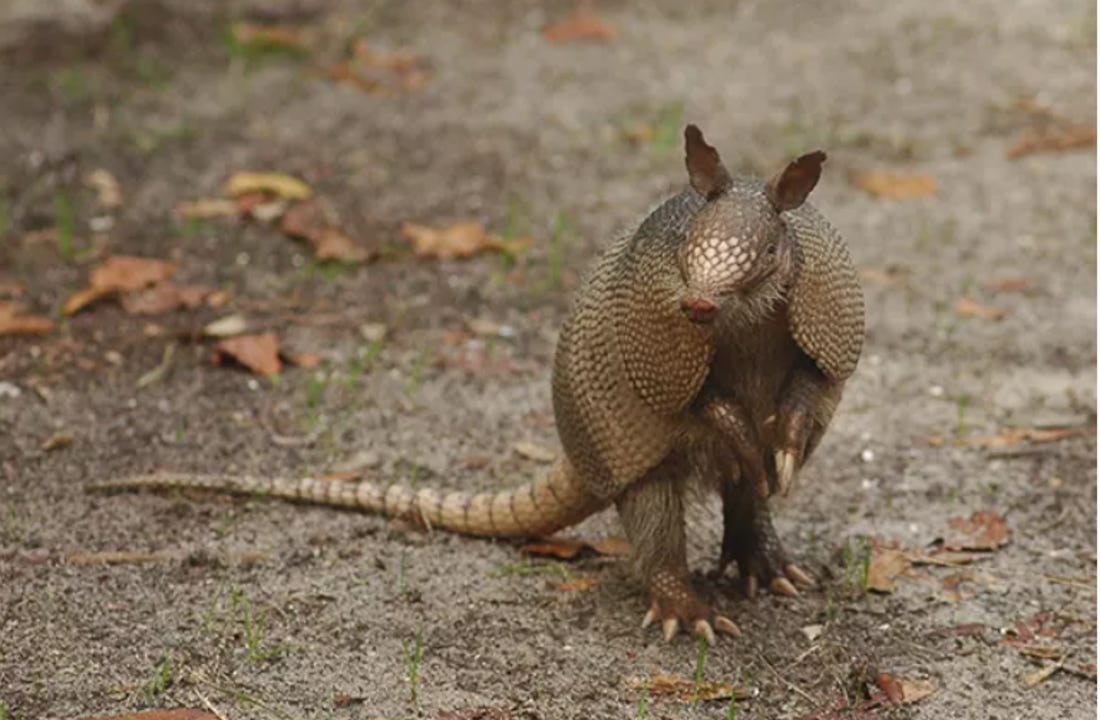
National Park Service photo
Traveling from West Texas to the East, I was surprised to see armadillos in Tennessee. When did they move into Tennessee? Turns out they arrived in central Tennessee around 2007.1 The nine-banded armadillo was first recorded in Texas in 1849 and did not cross the Mississippi until the early 1940s. This makes it a relative newcomer to the United States. Apparently, the armadillo has expanded about ten times faster than what is expected of mammals, and since 1849 it has expanded all the way to Illinois and east to the Carolinas.2
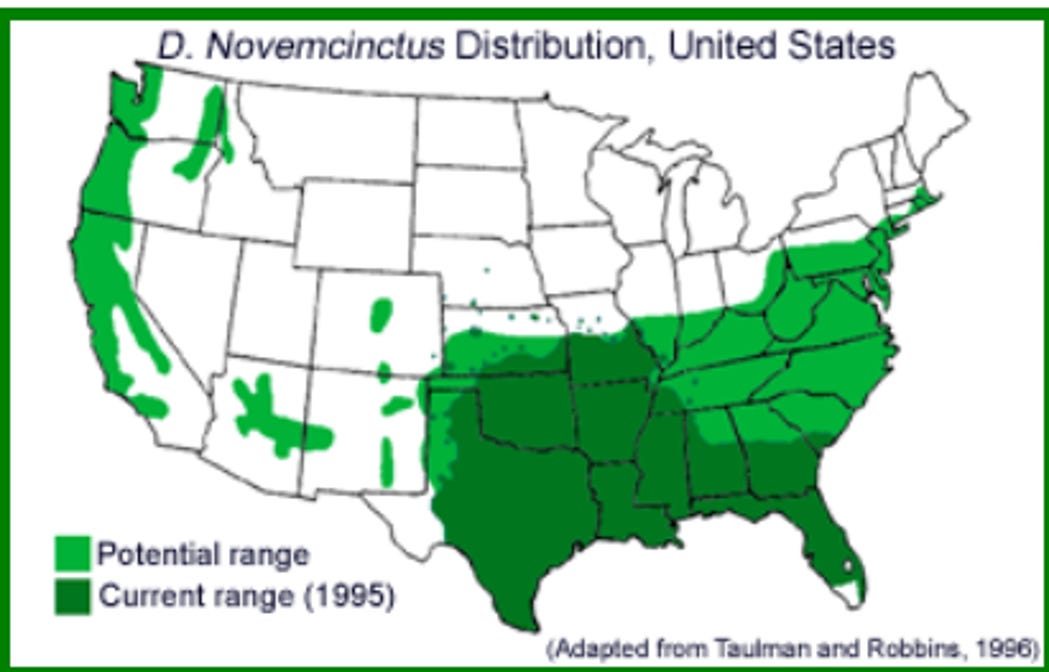
Range of the armadillo in 1995.3
The armadillo with its armored shell, claws, and pointy nose, has been difficult to categorize since early times. Early Spanish explorers in the 1500s, gave it the name, “armadillo” which means in the Spanish literal translation, the “little armored one”. In Central Mexico, the Nahuatl (one of the largest Indigenous tribes in Mexico) term for the animal was ayotochtli/ayotochin, literally “turtle or tortoise-rabbit,” from ayotl for “turtle” and tochtli or tochin for “rabbit”.4
In its Linnean classification, it is a mammal, then among mammals it is in the superorder, Xenarthra made up of armadillos, sloths and anteaters— a perhaps surprising association. Within the superorder, he sole surviving order for armadillos is Cingulata, comprised of armadillos and some of its extinct relatives. Within the order, there are only two families, and within one of those families, Dasypodidae, there is only one living genus, and within that genus, only one species is present in North America — the Nine-banded Armadillo, or long-nosed armadillo, Dasypus novemcinctus.5 However, in 2024, a DNA study concluded that the nine-banded armadillo is actually made of four genetically distinct species (not subspecies).6
Since the armadillo is a relative newcomer, Indigenous stories about the armadillo come from South America. A Mayan origin story tells of an underworld deity who turns his footstools into armadillos who jump up and knock over two visiting deities, then scamper away to be the progenitors of all armadillos. This story crosses over many Indigenous societies in the Southern Hemisphere where armadillos who live in underground tunnels, play a role in the underworld.7
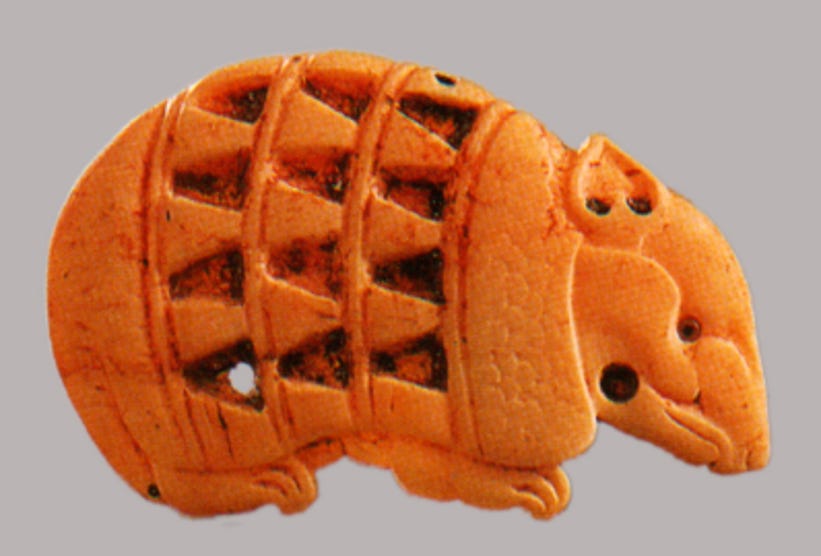
This is a classic Mayan representation of an armadillo, from Yaxha, Guatemala. Note the bands of repeating triangles on the shell, the claw-like feet, leafish ear, and downturned nose.8
Regulating the migrating armadillo in the United States
There is a patchwork of regulations covering the trade or possession of live and dead armadillos. Given the migration rate and range of the armadillo, you might expect the National Park Service to have some federal regulation of the armadillo, but instead, armadillos are regulated differently from state to state. Only when the Lacey Act is applied, does federal law apply9 which covers the interstate trade in armadillos if the state criminalizes it. States regulating the armadillo have three approaches: trade, hunting and pest designation.
Trade. Texas Parks & Wildlife Code § 63.103(a) provides that no person may sell or possess for sale a living armadillo, with exceptions for zoos, permitted educational and research institutions, and dealers reselling to those buyers. Subsection (d) authorizes a peace officer with probable cause to seize the animal and hold it for rabies or other communicable-disease observation, release it if clean, and destroy it if diseased; at the expense of the violator (subsection e). In state law, this violation is a Class B misdemeanor. However, Texas permits commercial dealers to possess, transport, purchase, sell, import, and export dead armadillos. Georgia regulates armadillos similarly: it is unlawful to possess live coyotes, armadillos, groundhogs, and beaver with exceptions for scientific research, wildlife exhibition and rehabilitation.10
Hunting. There are no hunting seasons for armadillos in Texas, North Carolina, — Georgia, or South Carolina—hunting is permitted year-round. In North Carolina it is a nongame species with no closed season or bag limit; nuisance animals may be trapped during the November–February regulated trapping season or taken under a depredation permit. Georgia affirmatively makes armadillos fair game, regulating that it is unlawful to take nongame wildlife except coyotes, armadillos, groundhogs, beavers, and a short list of others.
Pest designation. Louisiana notably names armadillos as "outlaw quadrupeds" alongside feral hogs and coyotes. Hunters with permits may take them year-round during legal shooting hours. Landowners or their agents can take them at night during legal shooting hours. On private property, armadillos may be taken with repeating shotguns holding more than three shells and from a moving land vehicle.11
Florida designates nuisance wildlife where any landowner may take nuisance wildlife, or authorize another to do so, by any method not on the prohibited list. No Gun and Light at Night Permit is required for armadillo, wild hog, coyote, or commensal rodents. Nuisance wildlife if captured alive must be euthanized within 24 hours.12
Designating the armadillo as nuisance wildlife, as a pest or allowing hunting with no seasons or limits means not only are armadillos unprotected, they are targeted for extermination. They are on no state endangered species list, or international list.
The Pet Trade
Armadillos are regulated as wildlife, but as pets (if not against wildlife law) they are regulated by the Centers for Disease Prevention and Control (CDC). Texas is one of the few overtly public-health-driven wildlife provisions in the country, and it is aimed at rabies in a commercial sale context.
in addition to rabies, nine-banded armadillos are naturally infected with Mycobacterium leprae (leprosy) and have been identified as the source of zoonotic transmission of leprosy in Texas, Louisiana, Alabama, Georgia, and Florida. A CDC survey of 645 southeastern armadillos found 16.4% with serologic or PCR evidence of infection, and 42.3% of 52 human patients from the same region carried one of two genotypes associated with armadillo.13
Meanwhile the documented exposure pathway — hunting, handling, butchering, and eating the animal — is legal, unlicensed, and mostly unlimited with regard to killing armadillos in the states discussed above. So nothing regulates the conduct (hunting, handling, butchering or eating armadillos) that actually transmits the organism.
Here is a starting point for checking the requirements for keeping an armadillo as a pet or if it is permitted at all in each state:
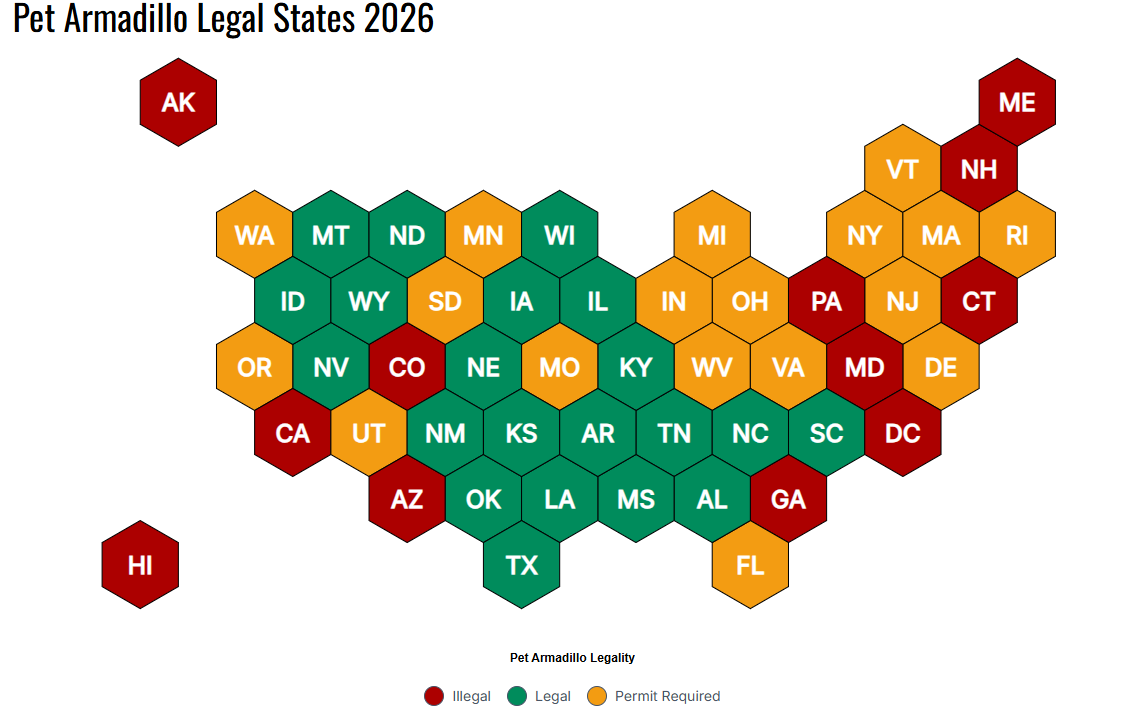
Armadillo pet regula tion by state.14
Since the armadillo was designated by the Texas Legislature as the state small mammal in 1995, it is only right to allow it to be kept as a pet. Quoting the law, the armadillo “possesses many remarkable and unique traits, some of which parallel the attributes that distinguish a true Texan, such as a deep respect and need for the land, the ability to change and adapt, and a fierce undying love for freedom.”15 Having some of the tenacious characteristics of Texans: However, that said, while it may be kept as a pet, live armadillos cannot be sold in Texas.
Final thoughts
Armadillos are literally fair game. They have no protections, state or federal, or even protections for methods of killing. They may or may not be regulated by animal cruelty statutes which do not regulate depredations. They could be pets, but as wildlife, keeping them as pets would either require a permit, or an exception in some states. They are actually pretty docile creatures, with the exception of their random jumping when startled.
The armadillo defies not only biological clarity with its classification and new DNA analyses, but is subject to a state by state assortment of legal approaches to its management that is unclear based upon its classification. Given the armadillo is not truly an invasive species, brought by humans, but expanded naturally into newer regions in North America over the past 150 years, many of these regulatory mechanisms may be a regulatory misfit, meant for the purpose of regulating predators, invasive species and dangerous animals.
Long live the armadillo.
https://smokieslife.org/2025/08/08/armadillos-make-a-home-in-the-smokies/
https://armadillo-online.org/expansion.html.
Taulman, J F, and Robbins, L W 1996. Recent range expansion and distributional limits of the nine-banded armadillo (Dasypus novemcinctus) in the United States. Journal of Biogeography 23: 635-648.
Newman SE, Rossi FD. THE FOX AND THE ARMADILLO: AN INQUIRY INTO CLASSIC MAYA “ANIMAL” CATEGORIES. Ancient Mesoamerica. 2023;34(2):360-382. doi:10.1017/S0956536121000638 at https://www.cambridge.org/core/journals/ancient-mesoamerica/article/fox-and-the-armadillo-an-inquiry-into-classic-maya-animal-categories/EAE46C40DC932AC8E7B5842BD8C17341 .
https://en.wikipedia.org/wiki/Armadillo
https://www.fieldmuseum.org/blog/widespread-armadillo-is-actually-four-different-species
Newman SE, Rossi FD. THE FOX AND THE ARMADILLO: AN INQUIRY INTO CLASSIC MAYA “ANIMAL” CATEGORIES. Ancient Mesoamerica. 2023;34(2):360-382. doi:10.1017/S0956536121000638 at https://www.cambridge.org/core/journals/ancient-mesoamerica/article/fox-and-the-armadillo-an-inquiry-into-classic-maya-animal-categories/EAE46C40DC932AC8E7B5842BD8C17341.
https://www.cambridge.org/core/journals/ancient-mesoamerica/article/fox-and-the-armadillo-an-inquiry-into-classic-maya-animal-categories/EAE46C40DC932AC8E7B5842BD8C17341
Lacey Act, 16 U.S.C. §§ 3371–3378.
O.C.G.A. §§ 27-2-12, 27-2-13, and 27-2-22 and at https://rules.sos.ga.gov/gac/391-4-2.
https://www.wlf.louisiana.gov/news/new-regulation-on-nighttime-take-of-outlaw-quadrupeds-nutria-and-beaver-to-go-into-effect-aug-1
https://regulations.justia.com/states/florida/68/68a/chapter-68a-9/section-68a-9-010/
https://wwwnc.cdc.gov/eid/article/28/3/21-1295_article
https://worldpopulationreview.com/state-rankings/pet-armadillo-legal-states
https://lrl.texas.gov/legis/billsearch/billdetails.cfm