
Winter is coming. . .
Is there really a coming Ice Age in the face of decades of Global Warming Warnings?


The prediction of a coming Ice Age was first published in an article in 1956 Science magazine, after research about what caused the past ice ages, led the researchers to predict another one would be coming.1
I will share a personal story with you which I do not often do, but since I was at the U.S. EPA at a pivotal time in history with the first introduction of climate change research and the first Framework Convention on Climate Change led by the United States, it may be worth sharing. I had just graduated with a Ph.D. in Environmental Sciences, with risk communication as my special dissertation area of expertise. As a political appointee of Pres. George H.W. Bush, I was assigned to what we called the “policy shop” as a communications specialist. It was my dream job. I remember one day cleaning up the media room, and there was a documentary on The Coming Ice Age, and I thought this should be useful given the discussion about global warming, right? I was told it needed to go to storage. I was confused at first, but I got the messaging. Even though we knew there was a coming Ice Age, to talk about it would muddle the message about global warming.
In an interesting turn, just this month, former Vice President, Al Gore, talked about a coming Ice Age in Europe, at the Conference of Parties meeting (COP30) on the Global Climate treaty. The COP30 also just revised its predictions for global warming, discrediting the extreme predictions of the warming models, saying the warming will likely be more in the moderate range of the model prediction. They reduced the 4.5 degrees C to 3.5 degrees C predicted warming for the worse-case-scenario.2 But do not celebrate too fast — the moderate range selection is also because the IPCC found that the lower level model predicting 1.5 degrees C rise, has largely been determined to be too low. (The models typically used three predictive levels, a low level, a moderate and an extreme/worse-case-scenario level, accounting for the uncertainty in the factors that are used to run the model about things we have to guess about.)
This is not to say that Al Gore has changed his position on global warming, just that he has introduced the complicating factor of a coming Ice Age, that had not been discussed in this context. Global warming might even prevent an Ice Age altogether was some of the wisdom. However, more to the point, he was trying to say that there will be regional differences — some regions will get warming, some regions will get cooling.
The Science
The “ice age” mechanism is the Atlantic Meridional Overturning Circulation (AMOC) — the system that includes the Gulf Stream and pulls warm tropical water north. A June 2025 study in Geophysical Research Letters found that in an intermediate emissions scenario, greenhouse gas-driven warming would not be able to outweigh the cooling impact of an AMOC collapse. As you see in this diagram, the warm (red) streams collapsing would be overwhelmed with the cooling (blue) and more cooling would result.3
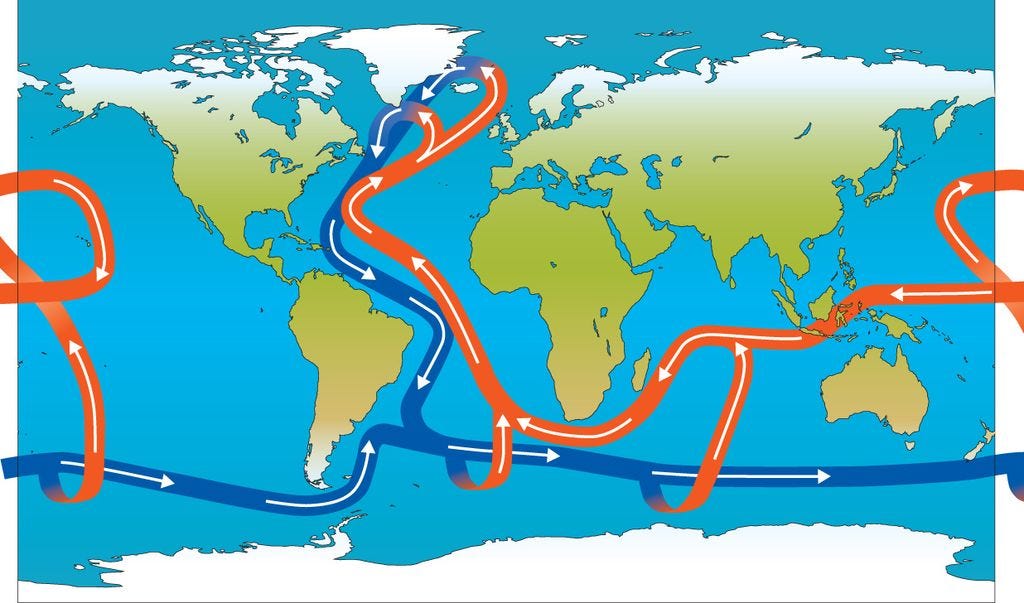
In that model, one-in-10 winters in London could see cold extremes approaching -20°C, and winter extremes in Oslo could plummet to around -48°C. The "State of the Cryosphere" report says AMOC may be en route to collapse because of ice melt and water warming, with impacts including cooling of Northern Europe faster than 3°C per decade, "with no realistic means of adaptation."4
In a fortunate turn of events for Europe, it appears that global warming may slow the coming ice age from 50,000 to 100,000 years from now.5
But there is still an unclear picture even with a review of 34 climate models. A 2025 Nature study examined the future stability of AMOC in 34 climate models and found an AMOC collapse this century was "unlikely." Research published in Nature Geoscience in 2025 found AMOC would experience "limited weakening" of 18-43% by 2100 even in a very-high emissions scenario.6
Then there are also predictions of a coming “mini Ice Age”.7
Climate change vs. global warming
Climate change would seem to be a better description but it misses the messaging of warnings about warming. From the historical record, climate change was first discussed in science in 1956, global warming in 1975. Thereafter, global warming dominated the messaging, but in the 2000s, climate change began to replace global warming to describe the complexity of regional changes.8
The Intergovernmental Panel on Climate Change (IPCC), was consistently the same since its formation in 1988. The United Nations Framework Convention on Climate Change (UNFCCC) was the first treaty which started the many treaties and protocols that followed. The three panels of the IPCC — science, policy and economics — have consistently met to develop consensus reports on these topics, and they have maintained their original name reflecting “climate change.”
Final thoughts
Climate change is complex and messaging with a message so simple that it leaves out critical parts of the problem has probably led to a distrust of government and science. This has probably also contributed to the political polarization of the issue, where it is seen as black and white —when it is mostly gray. Thirty years of the world’s meetings on climate change predictions, targets and timetables, it has been a demonstration of unprecedented cooperation on trying to understand a global phenomena and potential threat. Adjusting climate models to reflect vast amounts of data collected over the past decades is exactly what should be happening. Further, maybe more discussion about the complexity of the predictions should become more frequent. Then extremist ideas, like geoengineering would be much easier to see how misguided they are.9
It is a complex issue and for decades it has been too simple, creating distrust and too focused on reducing energy use which is directly related to annihilating the economy. More discussion about adaptation and mitigation and less about dropping the global GDP to levels of economic ruin, might even lead to more efficiencies in energy useage and more unified minds in a global approach to the phenomena based on these realities.
https://harpers.org/archive/1958/09/the-coming-ice-age/ This is a popular version of the Science magazine article.
https://ksapa.org/cop30-is-business-ready-to-tackle-spp3-7-cataclysmic-scenario/
https://www.metoffice.gov.uk/blog/2024/the-atlantic-meridional-overturning-circulation-in-a-changing-climate
https://www.carbonbrief.org/ocean-current-collapse-could-trigger-profound-cooling-in-northern-europe-even-with-global-warming/
https://www.whoi.edu/ocean-learning-hub/ocean-topics/climate-weather/abrupt-climate-change/are-we-on-the-brink-of-a-new-little-ice-age/
https://interactive.carbonbrief.org/amoc-explainer/index.html
https://www.labmanager.com/new-ice-age-may-begin-by-2030-11630
https://gpm.nasa.gov/education/articles/whats-name-global-warming-vs-climate-change